Jan 15, 2026
Building Commissioning Firm Integrates AI to Scale Construction Quality Assurance
An independent engineering consulting firm is reshaping how construction quality assurance is conducted by integrating artificial intelligence with traditional commissioning practices.

An independent engineering consulting firm is reshaping how construction quality assurance is conducted by integrating artificial intelligence with traditional commissioning practices. Unlike software only inspection tools, Prasino Engineering embeds AI within a licensed engineering workflow, ensuring every finding is technically validated, code aware, and defensible. The approach addresses a persistent industry challenge: the shortage of experienced technical reviewers needed to verify complex building systems before occupancy.
Prasino Engineering has developed a market-ready inspection AI product that automates construction site photo analysis, reducing review time by 60 percent while increasing automated issue detection by 30 percent across pilot projects. Every AI identified observation is reviewed, curated, and issued under the supervision of licensed Professional Engineers, preserving engineering judgment while scaling review capacity. The technology represents a significant shift in how building systems are verified during construction, particularly as projects grow more complex and qualified reviewers become increasingly scarce.
The firm’s founder, George Karras, brings practical field experience in commissioning, forensic troubleshooting, and indoor air quality to guide the company’s operations strategy and client delivery. Karras also leads SiteInspector.AI as Founder and CEO, while serving as President of KX4 LLC, where he delivers electrical safety and arc flash training and compliance services. His focus centers on pragmatic engineering solutions that protect occupant health and reduce lifecycle costs. This field first perspective drives Prasino Engineering’s emphasis on constructibility, maintainability, and long term operational performance rather than checkbox compliance.
Traditional commissioning relies heavily on manual inspection and documentation, creating bottlenecks during critical construction phases. The AI-powered photo analysis system scales quality assurance processes, accelerates issue identification, and standardizes field observations across multiple project sites simultaneously. This approach allows Prasino Engineering to extend senior level technical review across projects without relying on scarce specialist labor. Ten pilot customers tested the beta version, demonstrating an average time savings of 60 percent per inspection workflow.
Field inspections are further augmented through the use of wearable devices and large language models, allowing engineers to capture observations hands free, reference standards in real time, and generate structured inspection narratives directly from the field. This reduces transcription errors, shortens reporting cycles, and preserves technical context at the point of observation.
Beyond AI integration, the engineering consulting firm distinguishes itself through comprehensive building systems verification. Services span new building commissioning, existing building commissioning, retro-commissioning, and building envelope commissioning. The firm also conducts energy modeling and simulation, whole building energy modeling, daylighting, and thermal load analysis. These services are integrated into commissioning activities to verify that design intent translates into actual building performance.
Building envelope services include diagnostic testing, thermal imaging, air barrier verification, and building pressure testing. The firm performs whole building blower door tests and assembly tests, achieving an average infiltration reduction of 32 percent after remediation. Duct leakage testing and moisture management strategies round out the envelope verification portfolio.
Air quality and thermal comfort analysis capabilities include volatile organic compound testing, carbon dioxide monitoring, and particulate testing for PM2.5 and PM10. Field teams deploy thermal imaging, infiltration testing, smoke pencil testing, and precision measurement using manometers and anemometers. The firm maintains current calibration certificates for all test equipment, deploying an average of 18 calibrated diagnostic instruments per large project.
Mechanical, electrical, and plumbing system testing covers heating, ventilation, and air conditioning systems including variable air volume systems, rooftop units, air handling units, water source heat pumps, variable refrigerant flow systems, and energy recovery ventilators. Hydronic and steam systems, domestic hot water, electrical distribution, lighting controls, emergency power, and building automation systems also undergo rigorous functional performance testing.
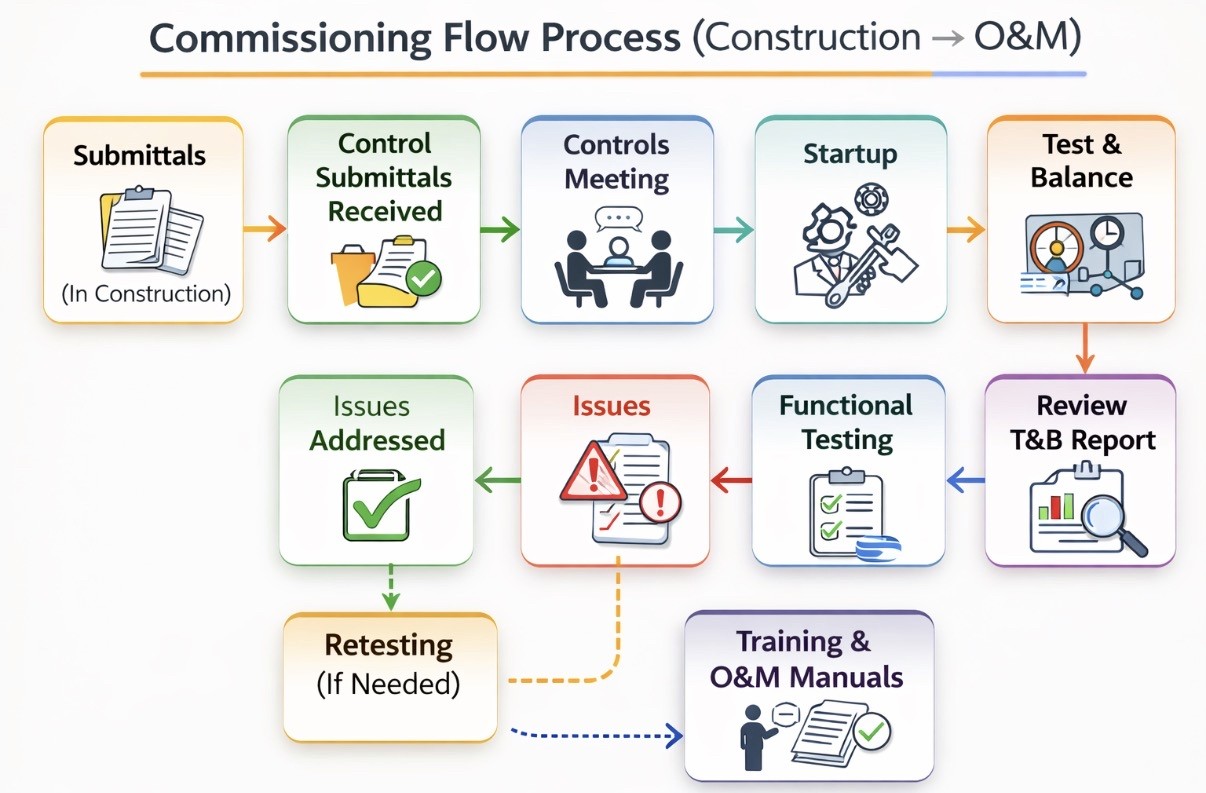
The firm’s proprietary commissioning software structures testing, documentation, and closeout for defensible, auditable results. The platform enforces standardized testing logic, issue categorization, and closure criteria across all projects. Deployed on 100 percent of projects, the platform has reduced test report generation time by 45 percent. This efficiency contributes to the firm’s track record: 92 percent of projects delivered on schedule and on budget, with average budget variance under 3 percent. Data captured through wearable devices and AI assisted field tools flows directly into the commissioning platform, enabling near real time issue logging, senior engineer review, and resolution tracking.
Performance metrics demonstrate consistent outcomes across the project portfolio. The firm closed 86 percent of commissioning issues prior to occupancy, with an average issue resolution time of 15 calendar days. Post-occupancy inspections conducted on 40 projects within 10 months of turnover showed 92 percent of systems meeting acceptance criteria at six months. The commissioning conducted by the firm reduced occupant comfort complaints by 70 percent within the first three months of operation. This reduction translates directly to lower facilities workload and fewer reactive service calls.
Energy performance represents another measurable outcome area. The firm delivered verified energy savings averaging 13 percent per project, producing average annual client savings of $28,000. Aggregate client savings reached approximately $420,000 last year. Energy modeling on various projects achieved predicted versus measured energy performance variance averaging just 7 percent, demonstrating accuracy in simulation and forecasting. This accuracy supports incentive verification, capital planning, and owner confidence in projected savings.
The firm provides direct leadership access throughout project lifecycles, maintaining continuity from start to finish. Commissioning activities are sequenced with construction to minimize disruption and identify issues early through collaboration with owners, architects, contractors, and inspectors. Engagement continues through turnover and the warranty period with post-occupancy check-ins to confirm systems perform as intended.
Conclusion
As Prasino Engineering scales its AI-powered inspection capabilities, the technology addresses fundamental constraints in construction quality assurance. The combination of licensed engineering expertise, calibrated diagnostic tools, proprietary software platforms, and artificial intelligence creates a verification framework that produces measurable outcomes. All commissioning reports reference ASHRAE standards and applicable code requirements to support defensible technical recommendations, maintaining professional accountability while advancing technological capability.
Published

George Karras
President, Prasino Engineering
News & Insights