Nov 16, 2025
2024 IECC Commercial Compliance
Commissioning, Envelope & Air Leakage, Energy Modeling, and Pressure Testing

Executive Summary
Air leakage of the building thermal envelope shall be tested by an approved third party in accordance with Section C402.6.2.1. The measured air leakage shall not be greater than 0.35 cubic feet per minute per square foot (1.8 L/s x m2 ) of the building thermal envelope area at a pressure differential of 0.3 inch water gauge (75 Pa) with the calculated building thermal envelope surface area being the sum of the above- and below-grade building thermal envelope. Various exceptions exist, refer to code for exceptions.
Thermal bridges, now prescriptive (C402.7). Identify and mitigate major above-grade wall thermal bridges (balconies/slabs, cladding supports, structural penetrations, fenestration intersections, parapets). Exceptions apply (e.g., Climate Zone 0–3 and very low-conductivity elements).
On site renewable (C405.15) sized at 0.75 W/ft² × FLRA (sum of conditioned floor area, capped at the combined area of the three largest floors) required.
Energy (electric and gas) monitoring (C405.13). Buildings ≥10,000 ft² must measure, monitor, record, and report by load and end-use categories with at least 36 months of onboard history.
Buildings shall be provided with on-site renewable electricity generation systems with a direct current (DC) nameplate power rating of not less than 0.75 watts per square foot (8.1 W/m2 ) multiplied by the sum of the gross conditioned floor area of all floors, not to exceed the combined gross conditioned floor area of the three largest floors.
Performance compliance will be demonstrated via one of the following paths: IECC 2024 C407 Simulated Building Performance; ASHRAE 90.1 2022 Section 12—Energy Cost Budget (ECB); or ASHRAE 90.1 2022 Normative Appendix G—Performance Rating Method (PRM). Under IECC C401.2.2, use of ASHRAE 90.1 2022 is an approved alternative. Recommendation, proceed with ASHRAE 90.1 2022 Section 12 (ECB) as the modeling path.
Commissioning Scope & Trigger (C408)
Trigger. Commissioning (Cx) of mechanical and service water-heating (SWH) systems is required on most projects. Projects are exempt only when both conditions are met: building gross conditioned floor area <10,000 ft² and combined plant capacity for heating + cooling + SWH is <960,000 Btu/h. Components solely serving dwelling or sleeping units via listed simple systems are exempt as noted in C408.2 exceptions.
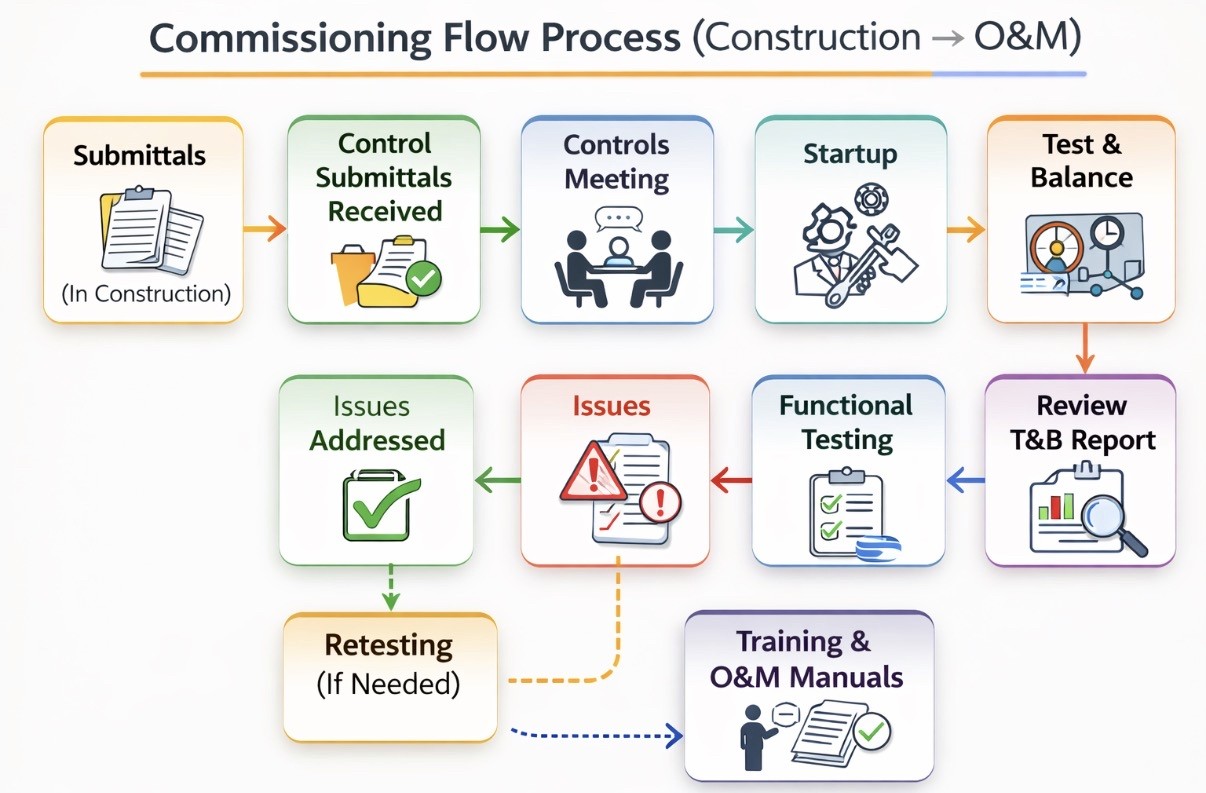
Scope & deliverables (mechanical/SWH). Provide a Cx plan in the construction documents; perform pre-functional and functional testing; deliver preliminary commissioning report before final mechanical/plumbing inspections; provide operations and maintenance (O&M) documentation and staff training; deliver the final commissioning report at turnover. Refer to C408.2, C408.2.4, C408.2.5.2, and C408.1.1.
Lighting and receptacle control acceptance testing (C408.3). Functional testing is required for automatic lighting controls and automatic receptacle controls. Documentation must be provided to the owner within 90 days of the certificate of occupancy (C408.3.2).
Building Envelope
Air barrier & verification. Provide a continuous air barrier and verify by whole-building test per C402.6.2 (exception for Climate Zone 2B). Testing must be performed by an approved third party using ASTM E3158 or an approved equivalent, with a formal test report (C402.6.2.1).
Construction documents. Show air-barrier location and sealing details, and identify thermal bridges, refer to C105.2 for documentation requirements.
Thermal Bridging - New Prescriptive Requirements (C402.7)
Scope. Identify and mitigate thermal bridges in above-grade walls, including balconies/slabs, cladding support systems, structural beams and columns that penetrate the envelope, interfaces with vertical fenestration (including spandrels), and parapets (refer to C402.7, C402.7.3–C402.7.4 for specific detailing and insulation requirements).
Exceptions. Not required in Climate Zones 0–3; not required for elements with thermal conductivity ≤3.0 Btu/h·ft·°F; exceptions also cover certain roof-edge/covering attachments and bridges already accounted for in assembly U- or C-factors (C402.7).
Design deliverable. Identify thermal bridges and show mitigation strategy in the construction documents per C105.2.
Energy Monitoring (C405.13)
Threshold & scope. Buildings ≥10,000 ft² must measure, monitor, record, and report energy consumption (gas and electric) by defined load and end-use categories (refer to C405.13.2 and C405.13.8). Electrical energy across building and associated site loads is explicitly included (C405.13.1).
Acquisition and reporting. Source and end-use meters must automatically communicate to a central data system (C405.13.3–C405.13.4). Provide a reporting interface with day/week/month/year views and at least 36 months of on-site data retention (C405.13.5).
Existing Buildings (Chapter C5)
Mechanical (HVAC) alterations. When the alteration requires compliance with C403, the mechanical systems serving the altered work must comply with C408.2.2 (adjusting & balancing), C408.2.3 (functional performance testing), and C408.2.5 (documentation). Exceptions: buildings <10,000 ft² and combined heat/cool/SWH capacity <960,000 Btu/h; systems in C403.5 serving individual dwelling or sleeping units. Code hook: C503.3.2.
Service water heating (SWH) alterations. When the alteration requires compliance with C404, the SWH systems serving the altered work must comply with C408.2.3 (functional testing) and C408.2.5 (documentation). Same small building and dwelling/sleeping unit exceptions apply. Code hook: C503.4.1.
Interior lighting / controls alterations. If you add/relocate full height partitions, or alter interior lighting or lighting controls, the affected spaces must comply with C405.2 (controls) and C405.3 (LPD), and functional testing per C408.3 applies to the altered automatic lighting and automatic receptacle controls. Code hook: C503.5.1 → C405.2/C405.3/C408.3.
Provide lighting/receptacle control documentation to the owner within 90 days of the CO per C408.3.2.
Exterior lighting / controls alterations. If connected exterior lighting power is increased by >400 W, all exterior lighting must meet C405.5 (performance).
Where exterior controls are added or altered, those portions must meet C405.2 and undergo functional testing per C408.3. Code hook: C503.5.2.
Building Pressure Testing Playbook
Design phase: Depict air-barrier continuity and thermal bridges on construction documents (C105.2). Specify whole-building air-leakage testing per ASTM E3158 with acceptance criteria (C402.6.2/C402.6.2.1). Include Cx scope and deliverables (C408.2).
Construction: Pre-test QA/QC of penetrations, electrical/communication boxes (C402.6.1.2.2), recessed luminaires, and known bridge details.
Testing: Air leakage of the building thermal envelope shall be tested by an approved third party in accordance with Section C402.6.2.1. The measured air leakage shall not be greater than 0.35 cubic feet per minute per square foot (1.8 L/s x m2 ) of the building thermal envelope area at a pressure differential of 0.3 inch water gauge (75 Pa) with the calculated building thermal envelope surface area being the sum of the above- and below-grade building thermal envelope.
Exceptions:
Where the measured air leakage rate is greater than 0.35 cfm/ft 2 (1.8 L/s × m2 ) but is not greater than 0.45 cfm/ft 2 (2.3 L/s × m2 ), the approved third party shall perform a diagnostic evaluation using a smoke tracer or infrared imaging. The evaluation shall be conducted while the building is pressurized or depressurized along with a visual inspection of the air barrier in accordance with ASTM E1186. All identified leaks shall be sealed where such sealing can be made without damaging existing building components. A report specifying the corrective actions taken to seal leaks shall be deemed to establish compliance with the requirements of this section where submitted to the code official and the building owner. Where the measured air leakage rate is greater than 0.45 cfm/ft 2 (2.3 L/s × m2 ), corrective actions must be made to the building and an additional test completed for which the results are 0.45 cfm/ft 2 (2.3 L/s × m2 ) or less.
Buildings in Climate Zone 2B.
Buildings larger than 25,000 square feet (2323 m2 ) floor area in Climate Zones 0 through 4, other than Group I and R occupancies, that comply with Section C402.6.2.3.
As an alternative, buildings or portions of buildings containing Group I-1 and R-2 occupancies shall be permitted to be tested by an approved third party in accordance with Section C402.6.2.2. The reported air leakage of the building thermal envelope shall not be greater than 0.27 cfm/ft 2 (1.4 L/s × m2 ) of the testing unit enclosure area at a pressure differential of 0.2 inch water gauge (50 Pa).
For buildings greater than 50,000 square feet (4645 m2), portions of the building shall be permitted to be tested and the measured air leakage shall be area weighted by the surface areas of the building thermal envelope in each portion. The weighted-average tested air leakage shall not be greater than the whole building air leakage limit.
On-Site Renewable
On site renewable sized at 0.75 W/ft² × FLRA (sum of conditioned floor area, capped at the combined area of the three largest floors). Qualifying constraints (poor solar resource, >80% roof obstructions, >50% roof shading >2,500 hours, or <5,000 ft²) shift the obligation to off site procurement per Eq. 4 11; approved instruments include physical/financial PPAs, community renewables, owner owned off site assets, RE investment fund, or a green retail tariff. If eligible off site supply cannot be secured, the fallback is a Green e–certified purchase equal to 5× the calculated off site energy.
Energy Modeling & Performance Pathways (C401/C407/C409)
ASHRAE 90.1-2022 alternative (C401.2.2). Projects may comply via the latest ASHRAE 90.1 edition allowed by the jurisdiction; 90.1-2022 is accepted under C401.2.2.
Simulated Performance (C407). The proposed design must meet mandatory provisions (C407.2) and achieve the required energy credits where applicable (C406.1). Performance analysis software must be ASHRAE 140-tested with published results (C407.5.1.2).
Heating, Ventilating, and Air-Conditioning (HVAC)O Total System Performance Ratio—TSPR (C409). A system-level performance method for applicable system/space types. Tools must meet C409.5.1 (ASHRAE 140 tested). Jurisdictions can require TSPR through Appendix CE.
Additional Efficiency Credits (C406). Each project must meet a credit target by occupancy and climate zone (C406.1.1). Credits span envelope, HVAC, lighting, TSPR options, and more (refer to C406.2 and credit tables).
Owner Impacts and Compliance Risk
Closeout: Submit Preliminary Cx Report before final inspection; deliver Final Cx Report at turnover; provide O&M docs and training; submit lighting/receptacle control documentation within 90 days of Certificate of Occupancy (C408.2.4, C408.2.5.2, C408.1.1, C408.3.2).
More projects require Cx. The 10,000 ft² + 960,000 Btu/h test captures many midsize buildings, budget for Cx agent and seasonal testing.
Envelope risk is front-loaded. The 0.35 cfm/ft² limit and corrective-retest clause drive early mockups and targeted QA/QC.
Thermal bridging is explicit. Balcony, parapet, and cladding attachment details need engineered mitigation, expect façade/structure coordination.
Permanent submetering. C405.13 adds hardware, integration, and reporting scope. Align Building Automaton System (BAS), IT/network, and metering packages early.
References
C105.2 — Construction documents; thermal envelope depiction.
C401.2.2 — Alternate compliance: ASHRAE 90.1-2022.
C402.6 — Air leakage (general); C402.6.1 — Air barrier; C402.6.1.2.2 — Electrical/communication boxes; C402.6.2 — Whole-building air-leakage testing; C402.6.2.1 — Test methods, reporting, and portion testing; C402.6.2.3 — Alternate compliance in Climate Zone 0–4.
C402.7 (incl. C402.7.3–.4) — Thermal bridging requirements.
C405.13 (incl. C405.13.1, .3–.5, .8) — Energy monitoring, data acquisition, reporting.
C406 — Additional efficiency credits; C406.1.1 — Credit targets; C406.2 — Credit options.
C407 — Simulated Performance; C407.2 — Mandatory items; C407.5.1.2 — Software ASHRAE 140 testing.
C409 — Total System Performance Ratio (TSPR); C409.5.1 — Tool testing; Appendix CE — Jurisdictional adoption of TSPR.
C408.1.1 — O&M docs and training; C408.2 — Mechanical/SWH commissioning; C408.2.4 — Preliminary report; C408.2.5.2 — Final report; C408.3 — Functional testing; C408.3.2 — Owner documentation timing.
Chapter C5 — Existing buildings: C502.3.7 (additions credit minimums); C503 (alteration triggers for acceptance testing).
Published

George Karras
President, Prasino Engineering
News & Insights