
Mar 11, 2026
Understanding the Mechanical Systems Commissioning Process During Construction
One of the most common questions we receive from owners, contractors, and design teams is simple:
What does the commissioning process actually look like during construction?
There is often a misconception that commissioning occurs only at the end of a project when equipment is turned on and tested. In reality, effective commissioning is a structured process that begins well before functional testing and follows a defined sequence to ensure building systems operate as intended.
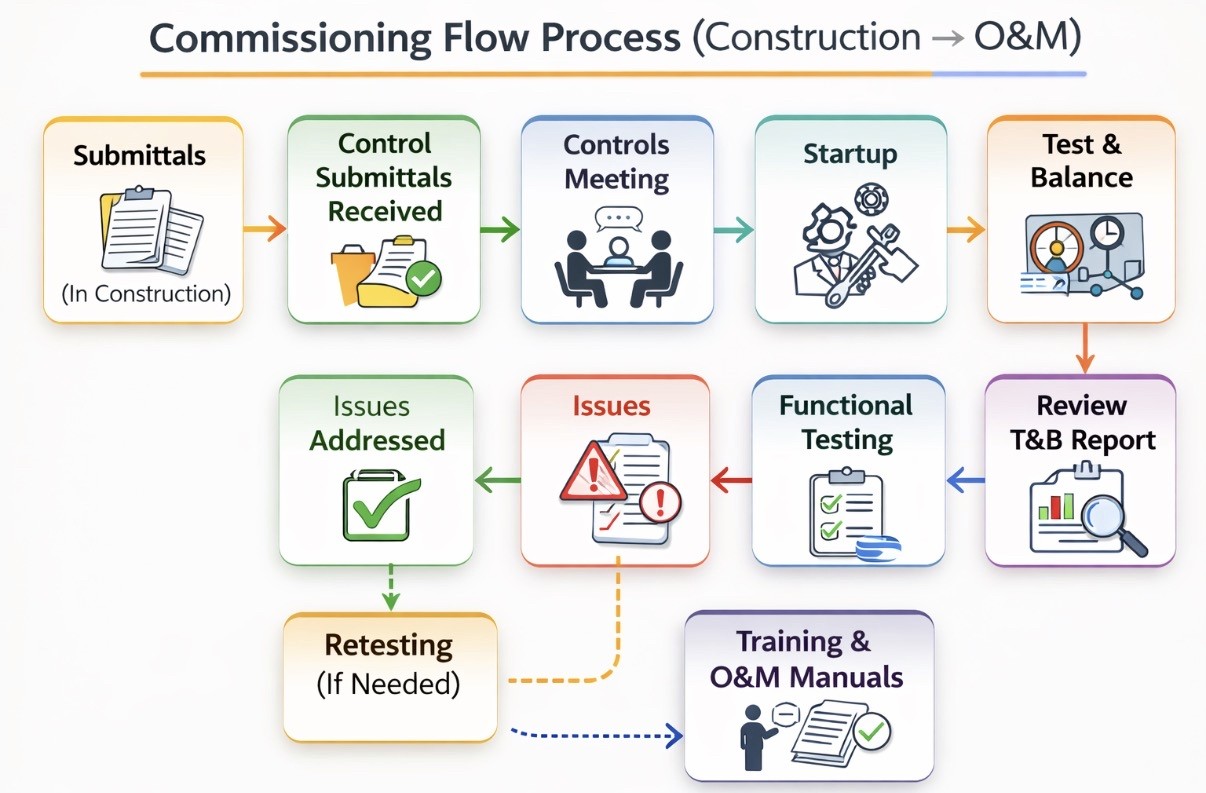
The flow chart shown illustrates a simplified commissioning workflow for mechanical systems during the construction phase.
The process typically begins with submittal review, where the commissioning provider reviews equipment and system documentation to verify alignment with the design intent. Once controls submittals are received, a controls coordination meeting is typically held to review sequences of operation, integration points, and overall system strategy.
Following coordination, the installing contractors perform equipment startup. After systems are operational, test and balance (TAB) is completed to verify that airflow and hydronic flow rates match design requirements. The commissioning provider then performs a TAB report review to confirm that reported values are reasonable and consistent with the design.
With the systems operating and balanced, the process moves into functional performance testing, where the commissioning provider verifies that equipment and control sequences operate correctly under various operating conditions.
During testing, issues are documented and tracked until they are resolved by the responsible contractor. In some cases, retesting is required to confirm proper corrective action. The process concludes with owner training and delivery of operation and maintenance manuals, ensuring that the facility team has the information needed to operate and maintain the systems effectively.
When this structured process is followed, issues are identified earlier, coordination improves among trades, and the owner ultimately receives a building that performs as intended.
Commissioning is not a single milestone at the end of construction. It is a disciplined quality assurance process that runs throughout the project lifecycle.
Published

George Karras
President, Prasino Engineering
News & Insights